
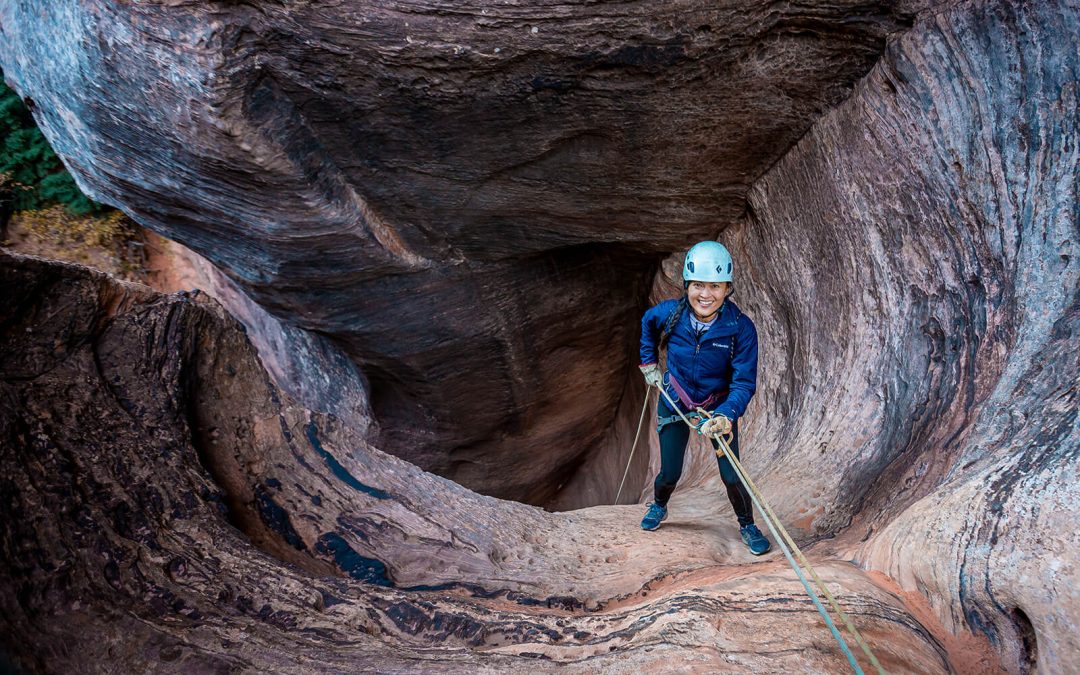
Why These 5 Zion Alternatives Beat the Angels Landing Crowd.
You refreshed the page at exactly 8:00 AM, heart racing, only to see the words that have forced many to pivot a vacation plan: “No Permits Available.” It’s the heartbreak of the 2026 Zion season.
Our guides know every inch of Water Canyon, ensuring you have a safe and thrilling day in one of Zion’s best-kept secrets.
With nearly 5 million visitors flocking to the park, the Angels Landing permit program has turned one of the world’s most iconic hikes into a high-stakes lottery. But here is the secret that the crowds at the visitor center don’t know: Angels Landing is just the tip of the iceberg.
While the masses are shoulder-to-shoulder on the chains, the real magic of Southern Utah is happening just outside the park boundaries. If you want the vertical thrills, the dizzying heights, and the narrow sandstone hallways without the red tape, it’s time to look at the “National Park Dupes” that offer more adventure with zero lottery stress.
Here are five Zion alternatives that are legally, scenically, and technically better than Angels Landing.
1. Half-Day Canyoneering on Kolob Terrace Road
The “Off-The-Beaten-Path” Specialist
If you were drawn to Angels Landing for the thrill of the “chains” and the exposure, canyoneering is the logical next step. While hiking Angels Landing is a linear path up a spine of rock, canyoneering is an immersive, multi-dimensional journey through the Earth.
Located just a short drive from Springdale, our half-day trips on Kolob Terrace Road—specifically areas like Lamb’s Knoll—take you to the high-country “Step” of Zion.
Why it’s better:
-
True Solitude: You trade the 800-person-per-day capacity of Angels Landing for a private experience. On Kolob Terrace, it’s just you, your guide, and the wind through the ponderosa pines.
-
Phenomenal Slot Canyons: You’ll navigate water-carved corridors and secret chambers that hikers on the canyon floor will never see.
-
The Views: From the top of the rappels at Lamb’s Knoll, you get 360-degree views of the Zion backcountry that rival any viewpoint inside the park.
“We often take families here because it offers that ‘big mountain’ feel with approachable, 100-foot rappels,” says our lead guide. It’s the perfect way to get off the beaten path without committing your entire day.
2. Full-Day Canyoneering: Water Canyon or Birch Hollow
The “Deep Wilderness” Experience
For those who wanted the physical challenge of a 5-hour hike like Angels Landing, our Full-Day Canyoneering trips are the ultimate upgrade. We focus on two legendary locations: Water Canyon and Birch Hollow.
-
Water Canyon: Located near Hildale, this is often called the “Subway Dupe.” It’s a perennial stream that has carved a stunning amphitheater into the cliffs. It features exhilarating rappels and breathtaking scenery that feels like a lush, hidden garden.
-
Birch Hollow: Sitting on the eastern boundary of the park, Birch Hollow is a “dry” canyon that offers a series of 10 to 12 stunning rappels. It eventually drops you into Orderville Canyon, providing that classic Zion “wall-to-wall” sandstone experience.
Why it’s better: Instead of just walking up a trail, you are using ropes, harnesses, and technical skills to descend through the heart of the rock. It’s a full-body adventure that makes a simple hike feel like a walk in the park.
3. The Zion Narrows (Bottom-Up)
The Iconic Classic (No Permit Required!)
Many visitors are shocked to learn that one of the most famous hikes on Earth—The Narrows—doesn’t require a permit if you do it as a “Bottom-Up” day hike.
You simply take the shuttle to the Temple of Sinawava, walk the 1-mile paved trail known as the Riverside Walk, and continue on into the Virgin River. You can hike as far as Big Spring (about 5 miles in) before you are required to turn back. We recommend walking to Wall Street as it is the most iconic part of the Narrows (about 3 miles in from the Temple of Sinawava).
Why it’s better:
-
No Lottery: As long as the river flow is below 150 CFS (cubic feet per second), you can go. No morning-of stress or six-month-advance planning.
-
The “Wall” Factor: At the “Wall Street” section, the canyon walls rise 1,000 feet straight up, and the canyon is only 20 feet wide. It is arguably more photogenic than the top of Angels Landing.
Note: Always check the 2026 Cyanobacteria alerts and flash flood potential at the Visitor Center before heading in!
4. The West Rim Trail (Past Scout Lookout)
The High-Altitude Pivot
Did you know that the permit for Angels Landing only starts at Scout Lookout? You can still hike the legendary Walter’s Wiggles—those 21 steep switchbacks—without a permit.
Once you reach Scout Lookout (where the permit checkers stand), most people stop. Don’t stop. Continue another 2 to 3 miles up the West Rim Trail.
Why it’s better:
-
Look DOWN on Angels: As you ascend toward the higher plateaus, you eventually reach a point where you are looking down on the top of Angels Landing.
-
Zero Crowds: 90% of the traffic stops at the permit station. The remaining 10% of the trail offers some of the most profound silence in the National Park system.
-
Wilderness Views: You’ll see the “Great White Throne” from angles that 99% of tourists miss.
5. Observation Point via East Mesa
The “Better-Than-Angels” Viewpoint
If you want the “Postcard Shot” of Zion Canyon, Observation Point is the undisputed king. Standing at 6,521 feet, you are actually 700 feet higher than Angels Landing.
Because the traditional trail from the canyon floor (Weeping Rock) is closed due to a massive rockfall, the only way to get there in 2026 is via the East Mesa Trail.
Why it’s better:
-
Perspective: You are looking down on the top of Angels Landing. It puts the entire scale of the park into perspective.
-
The Hike: The East Mesa trail is a relatively flat, 7-mile round-trip walk through a high-alpine ponderosa forest. It’s much easier on the knees than the grueling climb to Angels.
-
The Sunset: This is widely considered the best sunset spot in the park.
The Rock Odysseys Advantage: Why Go Guided?
In 2026, the biggest misconception about visiting Zion is that the adventure stops at the park gates. In reality, some of the most technical and breathtaking terrain in the world lies in the “Greater Zion” area.
Because the National Park Service prohibits guided technical trips inside the park, our team at Rock Odysseys has spent years scouting the absolute best “hidden” spots on public lands. When you book a trip with us, you aren’t just getting a guide; you’re getting:
-
Safety: Our guides are Wilderness First Responder certified and experts in rope systems.
-
Photography: We know the angles. We’ll capture those “hero shots” of you rappelling so you can stay in the moment.
-
Education: You won’t just see a canyon; you’ll learn about the geology, the flora, and the history of the Southern Utah desert.
Final Thoughts: Don’t Let a Lottery Define Your Trip
A permit is just a piece of paper; it isn’t a prerequisite for adventure. Whether you choose a quiet hike to Observation Point or a high-adrenaline day of rappelling with us, your best memories of Southern Utah will likely happen in the places where your cell phone doesn’t work and the crowds don’t go.
Ready to trade the permit line for a rappel line? Don’t spend your Zion vacation waiting for a “maybe.” Book your Canyoneering Adventure with Rock Odysseys today and see the side of Zion that most people only see in documentaries.